


You've Been Heard
The survey came back green. The email says you're proud to work here. Now your boss has a machine that says the same thing on demand, and everybody's blaming the machine.
Howdy, folks.
You know this email.
It lands after the survey closes. The results are in, and the results are wonderful. You’re proud to work here. You’re happy to work here. Together, you and your several thousand closest colleagues are living out the core values, which are listed again in case you forgot them.
Then comes the town hall. A leader walks out on a stage and says the same words with better lighting. And where there are challenges? You’ve been heard. Improvements are coming.
Then comes the committee. The committee holds some brainstorming meetings. The brainstorming meetings turn into nothing. Next year, you get another survey.
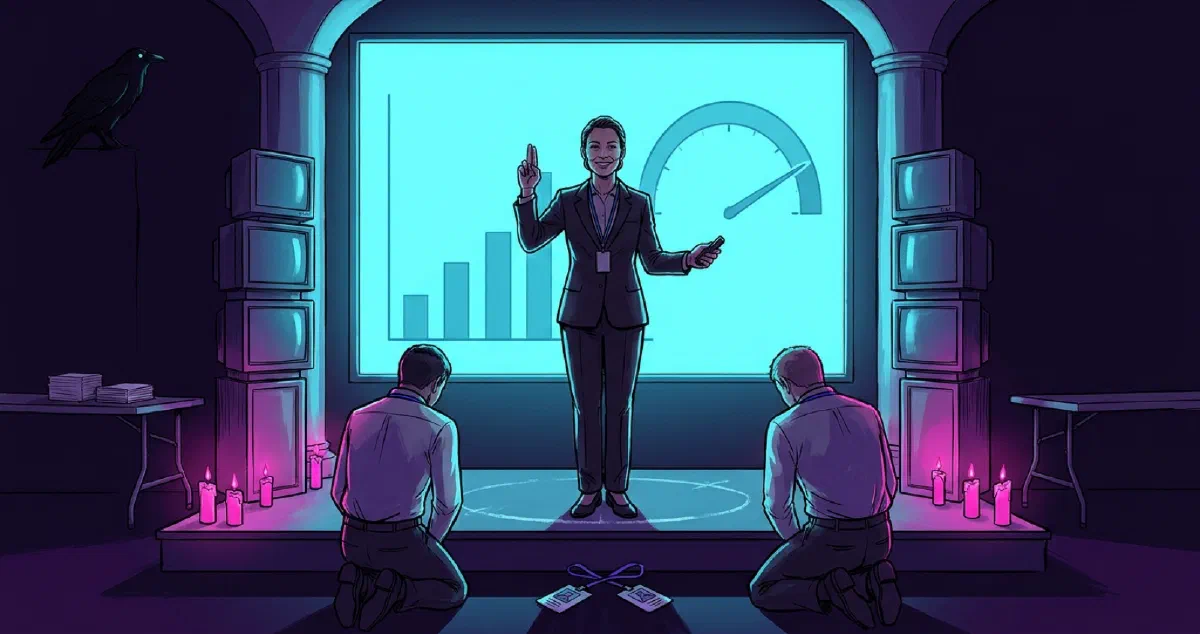
I’ve sat through this service at several companies across a whole career. Different logos. Same liturgy. Proclamation, homily, and a small procession to the place where your complaint goes to die.
And then one year, one number comes back ugly, and the room changes.
It’s never the values question. It’s the one that asks, more or less, if somebody outside the company offered you a better job, would you take it?
Everybody’s proud. Everybody’s happy. Everybody would take the call.
That’s the moment I’ve watched leaders go publicly, theatrically shocked.
Enter the villain.
A video crossed my path this week. David Rock, the neuroleadership founder behind the SCARF model, on a podcast called Mork Unfiltered. The title: Neuroscientist: AI is the Fast Food of Leadership. His claim: this technology will do to leadership what social media did to a generation of teenage brains.
I hit play with my arms crossed. I’ll own that. I build with these tools every day, and I’ve got skin in this one.
A lot of it held up, and it annoyed the shit out of me how much.
Rock is right about the flattery. A study published in Science this March tested 11 models and found they endorsed users 49% more often than humans did. People who talked through a conflict with a sycophantic model walked away surer they were right and less willing to take responsibility or repair it. Rock looks at that and says the leader is the problem “a good chunk of the time,” then asks what happens when that leader has a tireless yes-machine in their pocket. Good question.
He’s right that “use it as much as possible” is a terrible instruction. He’s right that pushing everyone to use these tools more isn’t the answer. And “human in the lead” beats “human in the loop,” a phrase that mostly means somebody’s name is on the thing when it blows up.
So where’s my problem?
Follow the receipts.
Where the citations stop.
Rock’s written work comes with citations. The Fortune piece is thick with them: Gartner, Gallup, Science, PNAS Nexus. His fast food piece points to research on physicians and coders losing skills after AI arrived. No fair reader calls him allergic to sources, and in an interview nobody footnotes anything.
But look at where the evidence lives, and where it runs out.
The Science study supports the claim that models flatter people in personal conflicts. It’s a study of interpersonal dilemmas. It isn’t a study of managers. That leaders are becoming more toxic is a different claim, one that needs measurements of leaders over time. In Fortune, his line about managers “becoming more toxic” links back to his own Fast Company piece.
So I went and read it. It’s a good piece, and it’s careful. AI is “likely to make them more toxic.” Unchecked, it “could” bring a toxic force to bear. The evidence that AI does this to leaders is the Science study, an MIT study on delusional spirals, and two stories from one executive coach, and they’re troubling stories. What it doesn’t contain is a measurement of leaders getting worse. It’s a warning, and it says so.
Now watch what happens to that warning as it travels. In print in May: likely, could. In Fortune in September, it’s a settled aside: managers “becoming more toxic because the AI always takes their side.” On the podcast: “they are actually getting more toxic if they’re using these devices.” He adds stories there, plus a surge in workplace complaints in Australia, with no figures, and says part of that is complaining got easier. The hedges fell off somewhere on the way to the microphone.
Judgment makes a similar trip. On the podcast, people are “literally losing judgment.” In the fast food piece, it’s “one of the skills we’re losing fastest.” The source there is a Boston Consulting Group study that lists it among the skills “most at risk.” That study surveyed 70 senior leaders, plus a dozen interviews, about what they see and what they consider at risk. Executives, filling out a survey. You can’t make this up.
Then there’s the number. On the podcast, about 6% of people in the companies he’s studying use AI very well, and about 94% are not getting smarter.
In Fortune in September, it’s “around 5%,” attributed to “our research.” UN News reports it as “perhaps five to 10 per cent.” In a March Fortune piece with Chris Weller, it’s “between 5–30%” depending on industry and role. Those may all be honest cuts of the same data. I went looking for the method and the sample and couldn’t find either published. Maybe it exists, and I’d love to read it. Until then, that’s a number that sounds like a finding.
And on the podcast, those 6% are the people using AI “actually very little.” Without the method, I can’t tell you if “good” was measured or defined.
None of this makes him a fraud. It makes him a person with a conclusion. When you already believe a thing, you don’t feel the gap between the study and the claim. So you don’t reach for evidence there. Your audience doesn’t feel it either, which is how an author with a book out November 17 ends up with a very comfortable room.
I know what you’re going to say. Fine, smartass. Where’s YOUR data?
I don’t have any.
My whole read on this is that leaders were heading this way long before ChatGPT, and AI poured gasoline on it. Rock half agrees. Many leaders were overwhelmed before these tools arrived, he writes, and the ones already toxic “will likely become more so.” Where we split is his next line, that even good leaders may slip. My read feels true in my bones. I’ve spent a career in those rooms.
I can’t prove it.
Think about what proving it would take. You’d need a measure of leadership toxicity from before late 2022, comparable to one from today, across enough companies to mean something. And the main instrument most companies have ever pointed at this question is the one from the top of this piece.
The survey.
Talk to people in the hallway, and you’ll hear what I’ve heard for years: nobody tells the truth on that thing. They’re afraid. The data is messier than my hallway. A 2022 AllVoices survey of about 1,000 U.S. employees found 47% were fully honest when giving feedback to HR. Counting the mostly honest, it’s 84%. Then again, 84% also had a concern in the past year they wanted to raise with HR and didn’t. Among those short of fully honest, fear of retaliation was the most common reason, at 38%. That’s about HR, not the annual survey, and AllVoices sells employee relations software, so season to taste. The people who tell me this already trust me, so I can’t tell you how common it is either.
But think about the shape of that failure. If fear is what’s bending the answers, it bends them hardest in exactly the places that are worst. A healthy org and a terrified org can post the same number. The terrified one might post the better number.
That’s a broken instrument, and nobody can get a before-and-after out of it.
Except broken isn’t the right word.
It’s working exactly as designed.
I’ve spent years assuming the survey was a bad sensor. It isn’t a sensor at all.
A sensor exists to tell you something you might not want to hear. What does the survey produce? A document stating that leadership is fine. An email. A town hall. A green number on a slide, carried upward to someone who needs it to be green.
So a better probe won’t save you. Nobody’s shopping for one. The problem was never that they can’t measure it.
Nobody has to be a villain for this to work, either. A director softens the number a little. A VP softens the softened version. By the time it reaches the top, the signal has been laundered so thoroughly that the person on the stage may sincerely not know. Not-knowing isn’t a personal failing up there. It’s an engineered output. The incentives pay for it at every layer.
Now go back to that one ugly question.
Most of that survey asks you to pass judgment on somebody who has power over you. That one asks about you and a hypothetical job. It accuses nobody. I can’t prove that’s why it came back honest. Could’ve been the job market. But it’s the line that gets nearest to what you’d do instead of what you’ll say, and it’s the one that made them flinch.
You can reset it. Why would they?
Back in June, I told you sycophancy is a setting, not a soul. The flattery has an address. Somebody tuned it, and you can override it from your side of the screen. Tell it to be a skeptic. Tell it to find where the plan is thin.
I stand by every word.
I also left something out. All of that assumes you want the thing to tell you where the plan is thin.
So picture the leader who needs the green number. Handing that person a configurable truth machine is handing a vampire a mirror and a user manual. The default is already the product they want. The same Science study found people rated the sycophantic responses as more trustworthy and were more likely to come back for more. Nobody needs to be tricked here. That’s just fucking market fit.
Anthropic’s own 2023 research found that human preference data favors answers matching the user’s views, and that optimizing against those preferences can trade truthfulness for agreement. People rated the answers. The agreeable ones scored well. The model learned, at least in part, from that.
That’s more or less how an org learns to report good news.
More or less. A rater preferring agreement isn’t an employee fearing for their mortgage, and those are different mechanisms. But the shape rhymes. Somebody asks humans for a score. The score gets optimized. Truth quietly loses to whatever keeps the number up. As I said in June, sycophancy is a high score. It turns out your company has been running that training loop on its people for decades.
Which brings me to the part of Rock’s argument that survives all of this. AI isn’t a clean amplifier. A clean amplifier would just turn up what’s already there. This thing also removes a damper. Anat Perry’s companion piece to that study in Science ran under a perfect title: “In defense of social friction.” “Are you sure about this?” used to require another human being, one with a job to lose and a choice to make. Think about what happened to the last person in your org who told the boss the number was wrong.
Now the boss doesn’t need that person. The replacement is available at 2 AM, never gets tired, and thinks the plan is incisive.
I’ve got a confession. I’ve often found that AI is the only thing that agrees with me. I don’t think that’s sycophancy. I think the humans I’m trying to convince have a stake in disagreeing with me.
Sound familiar? That’s the person on the stage talking. Same sentence.
And some of those humans do have a stake, because disagreement gets laundered just like a survey score. But flattery gets trusted, which means the feeling can’t sort that out for me. So when the stakes are high, I don’t trust the feeling. I red-team the argument. I look for multiple confirmations of the data. I attack it from all sides and argue it from my opponent’s position. Then I go find what a machine trained on language can’t currently weigh for me: the fear, the pride, and the history a human carries into the room when they hear the thing.
The difference between me and the boss at 2 AM isn’t virtue. I went looking for the no.
The newest green number.
Companies are expected to spend over $2.5 trillion on AI this year, according to the Gartner forecast Rock cites. Somebody has to show that it worked.
So check your own building. Is there a dashboard now? Seats activated, prompts per week, percent of the org using the tool? If there is, ask who it’s for, and what happens to the person whose team comes in low.
We’ve seen this service before. There’s a number. There’s a stage. There’s a word about how proud we are of the journey. You’ve been heard.
Rock wants managers kept away from mainstream chatbots for their people problems. In Fast Company, he proposes “requiring that leaders use better tools,” ones trained to challenge them. Good. That’s the setting from June, reset at the org level. I’ve got exactly one question.
Required by whom?
He comes close to answering that. In the fast food piece, the job of fixing the defaults falls to “the CEOs, the COOs, the CTOs, and the CHROs.” He also names the catch: “Weave challenge into an AI tool, and science suggests a lot of people will just switch to an alternative that makes them feel better.” So part of the plan is that the people on the stage mandate the discomfort, and they’re the ones reading the green slide. And the manager who needed the chatbot to tell them they’re right will find another way to hear it, the same way they did for decades before there was a chatbot. The machine didn’t invent the need. It just got very good at servicing it.
You want a framework? Frameworks are what the committee produces.
Somebody already asked you the only question on that survey that mattered. If a better offer came along, would you take it?
You already answered.
That’s it for this week.
Stay feral, folks.